Finding the Orion Nebula Through a Wall of Streetlight
M42 is supposed to be an easy target. It is, once you stop looking for it where the photos say it should be brightest.
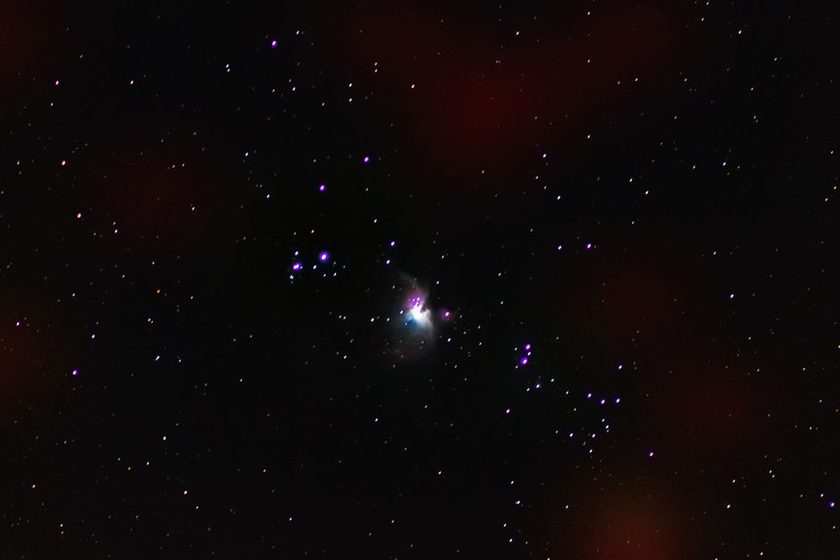
The first time I found M42 from this backyard, I almost didn't believe it. I'd spent an hour with binoculars pointed roughly at Orion's Sword, expecting something close to the wide, magenta-and-teal swirl I'd seen in a hundred astrophotography posts, and instead I got a smudge. A real smudge, gray and slightly fuzzy at the edges of a bright dot, sitting in a sky the color of a parking-lot puddle at midnight. It took me a while to accept that the smudge was the win. Once I did, M42 became one of the most reliable things I point at all winter, streetlight or not.
The gap between the photo and the eyepiece
Most people's mental picture of the Orion Nebula comes from a stacked, long-exposure image: dozens or hundreds of frames layered together, color-calibrated, often captured from a dark rural site with a cooled camera doing the work no human retina can do. That image is real, but it isn't what any single glance through an eyepiece delivers, and it's especially not what a Bortle 7 suburban sky delivers. Skyglow from streetlights and nearby development raises the background brightness enough that faint, extended structure gets washed out before it ever reaches your eye. The nebula's core still shows up because it's genuinely bright as deep-sky objects go, but the sweeping wings that make the astrophotography version so dramatic mostly stay hidden.
Once that expectation is reset, the target gets a lot more satisfying. You're not failing to see the photo. You're seeing the actual, live thing — a different experience with its own reward, closer to birdwatching than to viewing a printed poster.
Set the target correctly. Under Bortle 7 skies, expect a bright, slightly fuzzy core around the trapezium stars and a soft gray haze immediately surrounding it — not color, not wide wings. If you're waiting for the magenta cloud from the photos, you'll assume you haven't found it when you actually have.
What actually shows up at Bortle 7
Under my sky, with a 6-inch reflector and a low-power eyepiece, M42 reads as a compact, unmistakably non-stellar glow wrapped around the four tight stars of the Trapezium. The glow has a slightly greenish-gray cast to the eye rather than any of the reds or pinks a camera would pull out of it — human night vision just isn't built to register color at that faintness. The brightest section, the part closest to the Trapezium, is genuinely striking even under glow; it's the extended outer haze that thins out and disappears the fastest as sky brightness goes up.
A few things changed what I could see, in rough order of how much difference they made:
- Letting my eyes fully dark-adapt — even ten more minutes past the point where I thought I was adapted revealed more of the surrounding haze.
- Averted vision — looking slightly to the side of the nebula rather than straight at it puts the image on more light-sensitive parts of the retina, and the outer glow gets noticeably larger.
- Lower magnification — a wider, dimmer field concentrates the nebula's light better than cranking up power, which just spreads the same photons over a larger, darker patch of view.
- Timing around the Moon — a bright Moon anywhere in the sky adds its own glow on top of the streetlight glow, and the difference between a moonless night and one with a gibbous Moon up is larger than most of my gear changes.
Reading the shape instead of chasing color
Once I stopped expecting color, I started noticing shape, and that's where a light-polluted view of M42 gets genuinely interesting. The visible glow isn't a uniform blob; it has a rough fan or wing structure even to the eye, denser near the Trapezium and tapering unevenly outward. On a good night I can pick out that the haze isn't symmetric — it extends further to one side than the other, which is the naked-eye echo of the same asymmetric cloud structure the long-exposure images show in far more detail. Finding that asymmetry felt like a small win worth chasing, and it's a good exercise in learning to read faint extended objects generally, a skill that carries over to other targets.
The nebula didn't get brighter. My idea of what "seeing" it meant got smaller and more accurate, and that's what made it visible.
What actually improves the view
None of this requires new equipment, but a few adjustments to how the same gear gets used make a real difference under glow. This isn't a shopping list — it's what changed the outcome on nights with identical equipment and different technique.
| Adjustment | Effect on M42 | Cost |
|---|---|---|
| Wait for Orion near the meridian | Less atmosphere and less ground-level glow in the path | Free — just timing |
| Full dark adaptation, no phone screen | Outer haze becomes visibly larger and more defined | Free — 20-30 minutes |
| Lower magnification, wider field | Concentrates faint light instead of spreading it thin | Usually already in the eyepiece case |
| Block a nearby streetlight with a fence or tarp | Reduces glare that shrinks pupil size and kills adaptation | Free — positioning |
| Check the Moon phase before heading out | New-Moon nights show noticeably more of the outer wings | Free — a calendar check |
Site selection inside a small yard matters more than it sounds like it should. Standing where a fence, shed roof, or hedge blocks a single dominant streetlight — rather than standing in full view of every light on the block — measurably changes how quickly the eyes adapt and how much of the nebula's edge stays visible. It's worth walking a few different spots in the yard on a clear night before settling on a permanent observing position; the difference between two spots twenty feet apart can be surprising. For a more general read on how to plan around sky conditions before a session, see Everything I Check the Afternoon Before a Clear Night.
Where M42 sits relative to everything else worth pointing at
Orion's Sword is a good habit-forming target precisely because it rewards effort without requiring a dark-sky trip. It's bright enough to find in a Bortle 7 sky within seconds once Orion is up, but faint enough at the edges that the technique — dark adaptation, averted vision, patience — actually matters and actually pays off, which makes it a useful proving ground for the same skills used on fainter, more stubborn targets later. Binoculars will show the fuzzy core clearly; a small telescope resolves the Trapezium's four stars and starts to show the fan shape. If binoculars are still the primary tool in the bag, the note on Why the Best First Upgrade Is a Better Pair of Binoculars covers why that's a perfectly reasonable place to stay for a while before adding a telescope.
Field note
This is a record of one observer's sessions under a specific Bortle 7 suburban sky, offered for educational reference. Actual visibility depends on local sky glow, Moon phase, equipment, and individual eyesight, and will vary from what's described here.