The Five-Planet Line You Can Actually See From a Driveway
Not every "planet parade" headline holds up once streetlights get involved. Here's what actually cleared the roofline and what got lost in the glow.
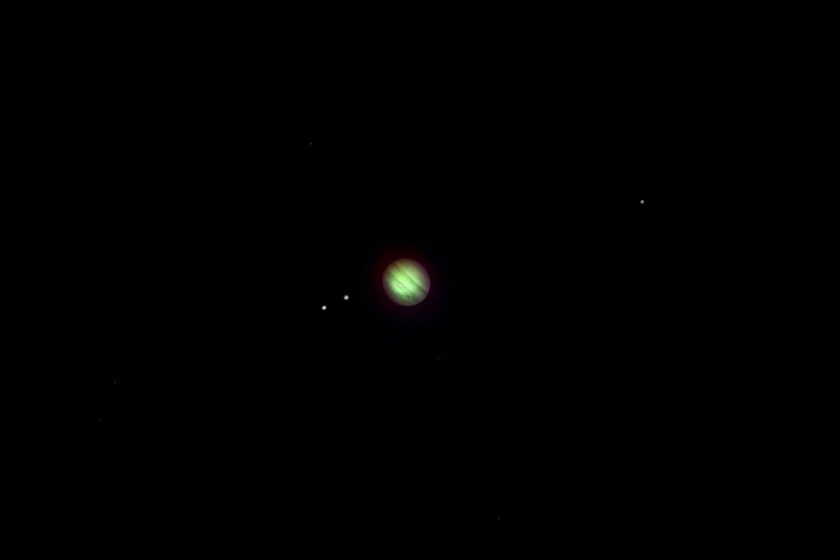
Every January somebody's headline promises a line of planets you can see with your own eyes, no equipment required. This year the phrase making the rounds was "five planets align at dawn," and it spread through neighborhood group chats faster than the actual conjunction moved across the ecliptic. I have a driveway, a fence line with three sodium streetlamps hanging over it, and eleven mornings in January when the sky actually cooperated. Here's what happened when I tested the claim against what a real suburban horizon delivers before 6:30 a.m., in a coat that was never quite warm enough.
What the Headline Actually Said
The claim, repeated across a dozen slightly different versions, was some arrangement of Mercury, Venus, Mars, Jupiter, and Saturn strung low across the eastern sky before sunrise, all five visible in a single glance upward. Technically true, in the sense that all five were above the horizon at some point during the same general week. What the headlines left out — because it doesn't fit in a headline — was altitude. A planet can be "up" and still sit nine degrees over a roofline, hide behind a bare oak, or sink into a dome of orange glow thrown by a cul-de-sac streetlamp. None of that shows up in a wire story. All of it shows up on a driveway.
The Two That Never Had a Chance From Here
Mercury and Saturn were the first casualties, and neither surprised me once I checked their numbers the night before. Mercury never climbed past about six degrees above the horizon during its best window, which sounds like a technicality until you remember that a six-degree object rises behind whatever's actually on your horizon — in my case, a neighbor's roofline and a leafless oak that manages to block more sky than a bare tree should. Saturn was worse: it spent most of the month sliding toward conjunction with the Sun, low enough and close enough to the brightening dawn that it never separated from the horizon haze. I logged "not found" for Saturn on four separate mornings before I stopped setting an alarm for it.
A planet parade printed in a press release assumes a horizon with nothing on it — no roofline, no streetlamp, no bank of low cloud sitting there every morning at six. My horizon has all three.
What Actually Cleared the Roofline
Venus, Jupiter, and Mars were a different story, and this is the part worth getting out of bed for. Venus was unmistakable — bright enough to throw a faint shadow across the frost on the car windshield, the kind of object that makes people who've never opened a star chart stop mid-stride and ask what it is. Jupiter sat higher and steadier, a flat white point that didn't flicker the way the streetlamp-adjacent stars did. Mars was the quiet one: a dim, rust-colored dot low in the southeast, easy to lose against the sodium-orange sky until I gave my eyes the full ten minutes they needed to adjust. Three planets, not five — but three that actually held still long enough to sketch in a notebook.
| Week of | What headlines claimed | Actually visible, naked eye | Best window | Notes from the driveway |
|---|---|---|---|---|
| Jan 3 | Five-planet line | Venus, Jupiter | 6:05–6:30 a.m. | Mars still buried in twilight glow |
| Jan 8 | Same claim, wider coverage | Venus, Jupiter, Mars | 6:00–6:35 a.m. | Mars finally cleared the horizon haze |
| Jan 13 | "Peak alignment" headlines | Venus, Jupiter, Mars | 5:55–6:30 a.m. | Best morning of the month; Mars easiest to hold |
| Jan 18 | Same claim, recycled | Venus, Jupiter | 5:50–6:20 a.m. | Mars faded back into glow as elongation shrank |
| Jan 20 | "Last chance" headlines | Venus, Jupiter | 5:45–6:10 a.m. | Twilight advancing faster than the planets receded |
Reading the Gaps Without an App
None of this required software running the actual morning of. The useful work happens the night before, which is the same habit I keep for every clear-sky decision covered in more detail here. For a dawn planet check specifically, three numbers matter more than any headline: altitude at your actual observing time, apparent magnitude, and elongation from the Sun. A planet under roughly ten degrees of altitude is fighting your horizon obstructions before it fights anything else. A planet dimmer than about magnitude 1.5 tends to lose to the sodium glow outright. And a planet within about twenty degrees of solar elongation is fighting the brightening dawn sky on top of everything else. One of those working against it, and the object gets hard. Two working against it, and you might as well sleep in.
The three-number check before you set an alarm
- Altitude at planned observing time — under about 10° usually means a roofline or fence line wins
- Apparent magnitude — anything dimmer than roughly +1.5 tends to disappear into a Bortle 7 dawn
- Elongation from the Sun — under about 20° generally means twilight beats you to it
- Direction of the nearest streetlamp relative to the target — glow travels farther than it looks like it should
What the Line Really Looked Like by January 20
By the last week, the "line" promised in January's first headlines had quietly become an arc of two points low in the southeast — Venus doing most of the visual work, Jupiter riding along for support. That's not a failure of the sky; it's just what a real dawn line looks like once you subtract the two planets your horizon was never going to show you. I'd still call the month a win. Three planets confirmed by eye from a driveway, cross-checked the night before the way I outline in what a Bortle map doesn't tell you until you're standing in the yard, is a better morning than five planets that only ever existed in a press release.
A note on "planet parade" language
Multiple planets sharing the pre-dawn or post-sunset sky is a routine consequence of orbital mechanics, not a rare astronomical event — arrangements like this recur on some cadence most years. The phrase "planet parade" describes how the arrangement looks from Earth at a given moment; it isn't a claim about how many of those planets will actually clear a given observer's horizon, magnitude threshold, or sky glow. Whether any specific planet is visible to any specific person depends on local altitude, brightness, and light pollution at the time they go outside, not on the headline.